[email protected] Sanmen, Taizhou, Zhejiang, China
0%

China’s electric motor industry offers a wide range of production-line suppliers, from specialist equipment makers to integrated automation providers. Choosing among them takes more than comparing quoted prices. Buyers should examine winding accuracy, assembly consistency, testing coverage, and the supplier’s ability to support installation and maintenance. Small details matter: a stable wire-tension setting, a repeatable rotor fit, and a clearly documented test result can affect output quality.

Quality expert W. Edwards Deming wrote, “Quality comes not from inspection, but from improvement of the production process.” That principle is relevant when evaluating an Electric Motor Production Line: inspection matters, but sound process controls matter too. This overview introduces leading Chinese manufacturers and considers their equipment range, customization options, automation capabilities, and service support. It also highlights questions buyers can ask, such as whether the line includes traceable test data and whether operators receive practical training. No shortlist is perfect. Public information can be incomplete, and supplier claims deserve independent verification. Readers should compare technical proposals against their motor design, target capacity, and quality requirements before making a decision. A polished factory tour is useful, but it cannot replace production trials or clear acceptance criteria.
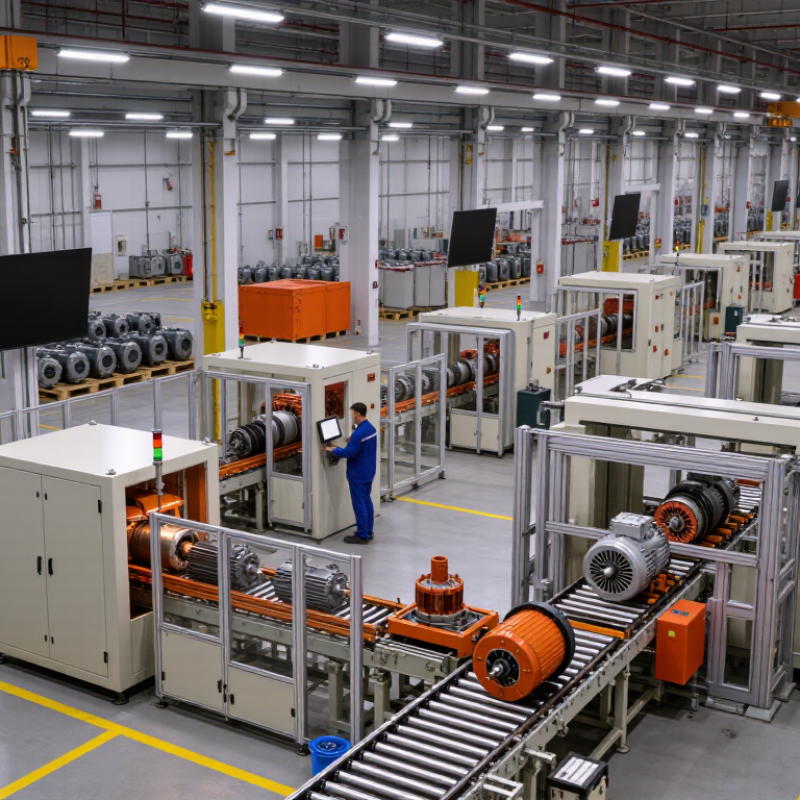
China Top Electric Motor Production Line Manufacturers

Overview of China’s Electric Motor Production Line Industry

China’s electric motor production-line industry is expanding alongside electrification in transport and manufacturing. CAAM reported 9.59 million new-energy vehicles produced in China during 2023. This downstream growth supports demand for traction motors, though vehicle output does not translate directly into motor-line orders.

A typical line links lamination stamping, core stacking, winding, rotor assembly, impregnation, balancing, and electrical testing. Operators watch winding tension and stack alignment closely; small deviations can affect noise, heat, and efficiency. Automated inspection and process traceability are increasingly important. Yet automation is not a cure-all. Product variety and frequent design changes can leave specialized equipment underused.

The IEA’s Global EV Outlook 2024 reported that China accounted for more than 70% of global electric-car production in 2023. That concentration encourages investment in flexible motor lines, especially equipment that can handle different stator and rotor configurations. Buyers still need to compare practical measures, including cycle time, first-pass yield, changeover time, and service support. A fast line may look impressive, but poor process stability can quietly erode output. Industry reports show demand signals; they do not replace factory-level validation.

Core Equipment and Stages in an Electric Motor Production Line

An electric motor production line begins with stamped steel laminations. A precision press cuts them, then a stacking fixture aligns the thin sheets into a stator core. Small details matter. Misaligned slots can complicate winding and reduce consistency. Automatic winding machines place copper wire into each slot; insertion tools protect the enamel insulation from sharp edges. Operators then check resistance and winding symmetry before varnish impregnation. The IEA’s 2011 report on electric motor systems estimated that these systems consumed about 45% of global electricity. That figure makes manufacturing quality more than a cosmetic concern.

Rotor production typically combines a laminated core, a shaft, and conductive bars or magnets, depending on motor design. Presses and joining equipment assemble the parts; balancing machines detect vibration before final assembly. Heat tells stories. Impregnation ovens need stable temperature control, while insulation testers can catch weak spots before a motor reaches the test bench. A dynamometer then records speed, torque, current, and temperature under load. Still, a line can look efficient on paper and lose yield through small process variations. Humidity, tool wear, and inconsistent curing deserve routine checks, not just attention after a failure.

China Top Electric Motor Production Line Manufacturers - Core Equipment and Stages in an Electric Motor Production Line

Typical stages and equipment used in electric motor manufacturing. The exact sequence and equipment depend on motor type, design, production volume, and required quality standards.

Production Stage Core Equipment Main Process Typical Quality Checks
Electrical steel processing High-speed stamping press, progressive die, or laser cutting system Cuts stator and rotor laminations from electrical steel sheet. Stamping is common for higher-volume production; laser cutting is often used for prototypes or smaller batches. Lamination dimensions, burr height, slot geometry, and material identification
Core stacking and joining Stacking fixture, interlocking press, welding station, or bonding equipment Aligns and joins laminations into stator or rotor cores while maintaining the specified stack length and geometry. Stack height, concentricity, alignment, and joining integrity
Stator winding Coil winding machine or needle winding machine Forms copper or aluminum wire coils to the specified turns, pitch, and winding pattern. The winding method depends on the stator slot and motor design. Turns count, wire tension, coil dimensions, and winding continuity
Coil insertion and forming Coil insertion machine, slot-liner insertion unit, and coil-forming tooling Places windings into stator slots, protects conductors with insulation where required, and forms the end turns to the designed shape. Insulation placement, conductor damage, slot fill, and end-turn clearance
Winding connection and lacing Lacing machine, lead-forming tools, and joining equipment Secures end windings and connects coil leads according to the motor’s electrical configuration. Joining methods may include brazing, soldering, or crimping, as specified by the design. Connection integrity, phase sequence, lead routing, and winding resistance
Insulation treatment Varnish impregnation system, vacuum-pressure impregnation system, and curing oven Applies insulating resin or varnish to windings and cures it to improve electrical insulation and mechanical stability. The treatment selected varies by motor design and application. Cure conditions, insulation resistance, dielectric withstand, and impregnation coverage
Rotor and shaft assembly Rotor assembly fixture, induction heating equipment, and press Fits the shaft and rotor components together. Squirrel-cage induction rotors and permanent-magnet rotors use different construction and assembly methods. Fit, runout, rotor dimensions, and magnet retention where applicable
Rotor balancing Dynamic balancing machine and correction station Measures rotor imbalance and corrects it by an approved method to reduce vibration during operation. Residual imbalance and compliance with the specified balance grade
Motor assembly Bearing press, rotor insertion fixture, end-shield assembly station, and torque tools Installs bearings and assembles the stator, rotor, housing, end shields, fan, and other specified components. Bearing seating, air-gap clearance, fastener torque, and free rotation
End-of-line testing Electrical safety tester, winding resistance meter, and motor performance test bench Verifies electrical safety and checks specified operating characteristics before release. Test items depend on the motor type and applicable requirements. Insulation resistance, dielectric withstand, winding resistance, no-load operation, and specified performance results

Note: Not every motor line includes every process listed. Equipment selection and inspection criteria should be matched to the motor’s design, production requirements, and applicable standards.

Leading Electric Motor Production Line Manufacturers in China

Leading electric motor production line manufacturers in China are best assessed by the equipment they integrate, not by broad claims. A capable supplier can plan winding, rotor assembly, balancing, testing, and material handling as one coordinated process. Ask for cycle-time data, changeover steps, and sample inspection records. These details reveal how a line may perform beyond a showroom demonstration. Practical engineering matters.

Factories differ in motor size, output volume, and automation needs, so a standard layout may not fit every plant. Discuss stator slot dimensions, coil insertion methods, bearing installation, noise limits, and traceability before finalizing specifications. Request a trial run using representative components and confirm how faults are logged. A clear service plan should cover commissioning, operator training, spare parts, and response times. Small gaps become expensive.

Supplier comparisons should include more than purchase price. Check whether the proposed controls exchange data with existing systems and whether key stations can be adjusted later. Automation can improve consistency, but it also adds maintenance demands. No line is perfect. Record unresolved assumptions and validate them during acceptance testing; a sound plan can still miss a production-floor constraint.

Manufacturing Technologies and Quality Standards

China Top Electric Motor Production Line Manufacturers

Manufacturing Technologies and Quality Standards

A capable electric motor production line pairs automation with checks at each critical stage. Automatic coil winding helps control turn count and wire placement. Operators still inspect end turns, because a neat-looking coil can hide damaged insulation. Small defects matter. Laser balancing can reduce rotor vibration, while precision machining keeps air gaps consistent. These details affect noise, heat, and service life.

Efficiency deserves the same attention as output speed. The International Energy Agency’s 2011 report, Energy-Efficiency Policy Opportunities for Electric Motor-Driven Systems, estimated that motor-driven systems used about 45% of global electricity. That figure makes efficiency testing more than a specification exercise. IEC 60034-30-1 defines efficiency classes for line-operated motors, while IEC 60034-2-1 sets methods for determining losses and efficiency. Manufacturers should test representative models under controlled conditions, rather than rely on design calculations alone.

Quality control should leave a traceable record. A practical line logs winding resistance, insulation tests, no-load current, load performance, vibration, and temperature rise. Calibrated instruments and repeatable sampling help buyers compare batches. ISO 9001 can support consistent process management, but certification alone does not prove motor performance. A test report is useful; it is not the whole story. Review sample results, measurement conditions, and how the factory handles failures. That last point is often less polished, yet revealing.

How to Evaluate Chinese Production Line Suppliers

China Top Electric Motor Production Line Manufacturers
How to Evaluate Chinese Production Line Suppliers

A supplier’s quoted output is only a starting point. Ask for a line-balance chart showing each station’s cycle time, operator needs, and planned buffers. Then compare the figures with your motor models and shift schedule. A fast assembly station cannot compensate for a slow winding or testing station.

Request evidence from a production trial, not only presentation slides. Review first-pass yield, changeover time, test coverage, and records linking each motor to its test results. The International Energy Agency’s 2011 report, Energy-Efficiency Policy Opportunities for Electric Motor-Driven Systems, estimated that these systems use about 45% of global electricity. That scale makes reliable efficiency and quality checks important. Confirm that end-of-line testing measures the parameters your product requires, and ask how calibration is maintained.

Visit the workshop if possible. Watch a real changeover, inspect cable routing and guarding, and ask operators how faults are handled. Check the acceptance criteria, spare-parts list, training plan, and response times in writing. A factory acceptance test should use representative products and agreed pass conditions. The paperwork may look complete, yet small details still get missed. I would also ask for a short trial using my own components; it may expose fit or process issues that a supplier’s sample cannot.

FAQS

What are the main stages in an electric motor production line?

The line stamps and stacks steel laminations, winds the stator, assembles the rotor, and tests the finished motor. Each stage needs careful checks.

Why does stator alignment matter?

Misaligned slots can make wire insertion harder and reduce consistency. A small shift may cause trouble later.

How are copper windings protected during production?

Insertion tools help prevent sharp slot edges from damaging wire insulation. Operators also inspect winding resistance and symmetry.

What checks help identify rotor problems?

Balancing machines detect vibration before final assembly. Load tests can also record speed, torque, current, and temperature.

Which production details should buyers discuss with a supplier?

Review motor dimensions, cycle times, changeover steps, fault logging, and service support. Ask for sample inspection records, too.

Why run a production trial before accepting a line?

A trial with representative parts can reveal layout or process issues. A showroom demonstration may not show everything.

What quality records are useful for comparing motor batches?

Check winding resistance, insulation results, no-load current, vibration, and temperature rise. Measurement conditions matter.

Does more automation always improve production?

Automation can improve consistency, but it adds maintenance needs. Not always. Record open questions and test them on the production floor.

Conclusion

China’s Electric Motor Production Line industry has developed into a broad manufacturing sector serving applications from household appliances to industrial machinery. A typical line combines equipment for core preparation, winding, assembly, impregnation, balancing, and final testing. The layout and level of automation vary according to motor design, production volume, and required performance, so understanding each stage is essential when planning a new facility or upgrading an existing one.

Manufacturers may use technologies such as automated handling, precision winding, digital process monitoring, and in-line inspection to improve consistency and efficiency. Quality systems and testing procedures help verify electrical performance, safety, durability, and compliance with relevant standards. When evaluating Chinese production line suppliers, buyers can compare technical capabilities, customization options, equipment integration, quality controls, installation and training support, spare-parts availability, and long-term service. A clear assessment of these factors helps identify a solution suited to both production goals and operating requirements.

Elliot

Elliot

Elliot is a professional marketer with a deep understanding of the company’s products, their features, and the practical needs they are designed to address. He brings together product knowledge, customer insight, and clear communication to make complex information useful and easy to understand.......