[email protected] Sanmen, Taizhou, Zhejiang, China
OEM / ODM Manufacturer · Since 1998

Starting Motor Rotor Equipment: Complete Armature Engineering & Sourcing Guide

How Global Motor Manufacturers Source High-Output Starting Motor Rotor Equipment: High-Precision Automatic Armature Winders, Flat-Wire Shaping, Intelligent Commutator Welders & Continuous Impregnation Lines.

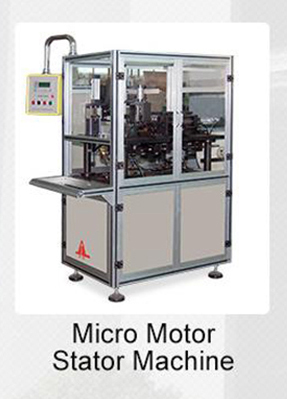
Starting Motor Rotor Equipment ZB-303 Three-Servo Automatic Rotor Wire Winding Machine
90+Machine Models
17National Patents

60,000 m² Base

Direct production in Sanmen, Zhejiang

ISO9001 & 3C

Verified automotive-tier repeatability

36 R&D Engineers

Custom tooling & automated cell design

Worldwide Deployment

Turnkey FOB, CFR, CIF export support

Technical Architecture

Engineering Precision Starter Motor Rotor Assembly Lines

Modern internal combustion engines, stop-start systems, heavy-duty commercial haulers, and marine propulsion drives impose rigorous electro-mechanical strains on automotive starter motors. Sourcing reliable starting motor rotor equipment requires balancing high winding slot-fill factors, metallurgical bonding at the commutator, dynamic rotational stability, and comprehensive dielectric insulation.

The Closed-Loop Armature Process Chain

The automotive starter motor armature rotor operates under massive locked-rotor currents (reaching 400A to 1200A depending on displacement) and extreme centrifugal forces. Manufacturing failures frequently occur when equipment vendors treat process stations as isolated modules rather than an integrated metallurgical and mechanical continuum.

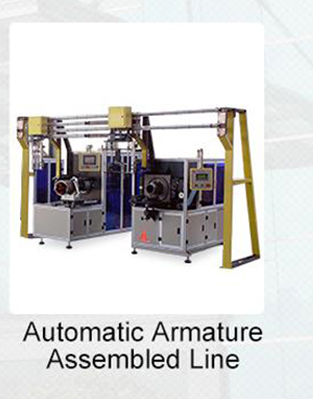
Zhejiang Rilvo Automation Equipment Co., Ltd. builds complete turnkey production layouts that synchronize eight essential production steps: automated shaft-to-lamination press fitting, slot cell insulation inserting, synchronized multi-axis flyer winding or flat copper hairpin shaping, intelligent commutator fusing/welding, slot wedge driving, diamond-tool commutator turning, dynamic automated unbalance correction, and continuous horizontal vacuum/trickle impregnation.

Eliminating Common Root-Cause Manufacturing Deficiencies

Automotive Tier-1 quality auditors constantly target four primary failure nodes during armature assembly audits:

  • Wire Enamel Damage: Controlled by our closed-loop tensioners that maintain dynamic wire tension within ±3% at 3000 RPM flyer speeds, preventing microscopic surface micro-fractures.
  • Commutator Weld Voids: Overcome via programmable inverter resistance spot welders with real-time displacement and current feedback to guarantee 100% molecular copper fusing.
  • Centrifugal Imbalance: Minimized through robotic dual-plane dynamic balancing drills capable of bringing residual unbalance below 0.3 g·mm/kg.
  • Dielectric Breakdown: Prevented through temperature-controlled horizontal trickle resin impregnation, delivering void-free slot fill.
Innovation Roadmap

Technological Trends in Starter Motor Armature Automation

Armature winding and assembly machinery is evolving rapidly from purely mechanical linkage drives to software-defined, servo-driven mechatronic cells.

Servo-Synchronized Multi-Axis Flyer Technology

Traditional mechanical cams and gear linkages suffer from backlash and continuous mechanical wear, causing erratic wire placement in high-slot-fill armatures. Next-generation winders like the Rilvo ZB-303 utilize independent digital servo loops for spindle rotation, flyer distribution, and indexing, which guarantees smooth deceleration at the hook tang without copper stretching.

Closed-Loop Energy-Controlled Fusing

Commutator welding has advanced from simple capacitive discharge to high-frequency inverter DC systems. Real-time dynamic resistance measurements detect poor electrode contact or loose copper strands within milliseconds, adjusting the power cycle dynamically to prevent commutator bar deformation or cold-soldered joints.

Automated Optical & Dielectric QA Integration

Instead of offline batch quality checks, modern starter rotor cells feature in-line machine vision for commutator slot positioning, alongside 5000V surge, insulation resistance, and welded-joint micro-ohmmeter testing built directly into the indexing starwheels.

Core Equipment Comparison Matrix

Process Step Legacy Standard Rilvo Automation Standard
Winding System Mechanical cam flyer 3-Axis servo dynamic profile
Tension Control Friction felt pads Closed-loop magnetic/servo tensioner
Commutator Weld AC Transformer spot weld Inverter DC with displacement QA
Bar Forming Manual die stamping Continuous CNC flat-wire shaping
Quality Verification Offline batch sampling 100% in-line electrical & vision QA
Enterprise Strengths

Zhejiang Rilvo Automation Equipment Co., Ltd.

Over 27 years of dedicated manufacturing experience, proprietary patents, and comprehensive vertical integration in Sanmen, Zhejiang, China.

Zhejiang Rilvo Automation Equipment Co., Ltd. Company Overview Factory Building
Rilvo Armature Assembly Workshop
FOUNDED1998
Company Overview

Engineering Excellence & Turnkey Capabilities

Zhejiang Rilvo Automation Equipment Co., Ltd. is a premier high-tech enterprise focusing on micro-motor manufacturing equipment, stator and rotor automation, precision welding systems, electric bicycle manufacturing and testing systems, and complete electrostatic powder coating lines.

Headquartered in the Shatianyang Development Zone of Sanmen, Taizhou, our campus spans nearly 60,000 m² of specialized manufacturing infrastructure with 20,000 m² of modern workshops and a further 30,000 m² under construction. Holding 17 national patents and full ISO9001 and 3C certifications, we supply over 90 distinct machine configurations engineered to exact customer rotor drawings.

Vertical Integration150+ In-House Machine Centers
Engineering Talent36 R&D Engineers · 8 Senior Titles
Global FootprintWorldwide Export to 40+ Countries
Acceptance Policy100% Pre-Shipment Sample Run
Purchaser Knowledgebase

Frequently Asked Questions: Sourcing Starting Motor Rotor Equipment

In-depth engineering answers to the critical technical and commercial questions global motor manufacturers ask when sourcing starting motor rotor equipment.

Request Custom Engineering Proposal
What equipment is needed for an automotive starting motor rotor line?

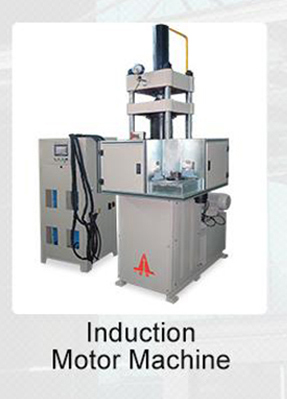
A full automated starter motor armature rotor production line requires: (1) Automatic shaft press fitting into the silicon steel core stack, (2) Armature core slot paper/Nomex insulation inserting machine, (3) High-speed multi-axis automatic rotor flyer winding machine (or CNC flat copper wire hairpin forming and inserting line), (4) Commutator hot-stake/inverter spot welding machine, (5) Slot wedge insertion and commutator tang crimping, (6) High-precision commutator turning and mica under-cutting lathe, (7) Automated dynamic balancing and multi-position milling/drilling station, (8) Horizontal resin trickle impregnation and curing line, and (9) Integrated electrical safety and surge tester.

Can Zhejiang Rilvo customize machinery based on our armature drawings and cycle time?

Yes. Customization is the core of our business model. When you supply your armature 2D/3D part drawings (rotor lamination OD, stack length, shaft dimensions, slot skew angle, commutator bar count, and magnet wire gauge), our 36-member engineering team calculates slot kinematics, models tooling interference, and creates bespoke flyer nozzles, gripper jaws, and welding electrodes. We tailor the entire layout to match your target cycle time, whether semi-automatic standalone cells or an interconnected conveyor line.

How does the machine prevent enamel abrasion and copper stretch on heavy wire?

Heavy magnet wire (ranging from 1.0mm to 2.2mm diameter) common in starter motor rotors is susceptible to enamel micro-cracking and wire thinning if subjected to sudden mechanical jerk. Zhejiang Rilvo integrates closed-loop magnetic powder and servo-driven active payoff tensioners. All contact rollers and flyer nozzles are fabricated from ultra-smooth tungsten carbide or mirror-polished ceramics with generous bend radii. Furthermore, our programmable winding software features S-curve acceleration and deceleration profiles that prevent tension spikes during slot crossovers and hook indexing.

What parameters ensure consistent spot welding between copper wire and commutator?

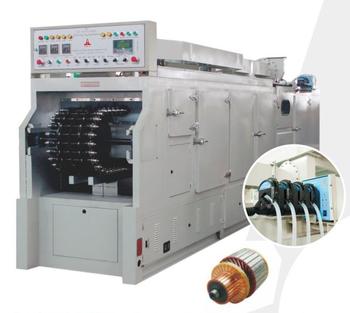
On models like our SDZ-120B Commutator Intelligent Spot Welder, we utilize medium-frequency inverter DC power. Quality relies on three synchronized parameters: precise pneumatic or servo electrode follow-up pressure, programmable multi-stage current ramping (preheat, weld, post-temper), and linear displacement sensing. The machine monitors electrode penetration depth in real time; if an unstripped wire strand causes high resistance or if a commutator bar overheats, the unit immediately alarms and isolates the defective rotor.

What are the lead times, delivery terms, and factory acceptance procedures?

Standard standalone starter rotor machines require approximately 45 to 60 calendar days, while customized automatic lines take 75 to 90 days. We ship FOB Ningbo/Shanghai, CFR, CIF, and EXW under T/T or L/C payment in USD or EUR. Before dispatch, we invite buyers for on-site acceptance or perform live streaming and high-definition video acceptance using your sent rotor cores, commutators, and magnet wire. Machines are crated in export-grade, moisture-sealed vacuum foil inside seaworthy wooden crates.

How do you provide overseas technical support and commissioning during setup?

Every piece of starting motor rotor equipment is accompanied by comprehensive English technical manuals, complete wiring schematics, spare-parts catalogs, and pre-recorded training videos. Our machines come equipped with remote diagnostic modules allowing our engineers to analyze PLC registers over secure Internet protocols. For full production lines, Zhejiang Rilvo dispatches bilingual commissioning engineers directly to your overseas facility to supervise physical erection, perform tool fine-tuning, and train your maintenance operators.

Direct Factory Collaboration

Upgrade Your Starting Motor Rotor Line Today

Connect with Zhejiang Rilvo Automation Equipment Co., Ltd. Send us your motor drawings, target production volume, and technical requirements. Our application engineering team will provide a comprehensive process concept, cycle-time simulation, and factory-direct quotation within 24 hours.

1 · Send Armature Drawing 2 · Engineering Layout Proposal 3 · Sample Trial Run & Video Sign-off 4 · Global Delivery & Line Support