[email protected] Sanmen, Taizhou, Zhejiang, China
Direct OEM Factory · Established 1998

How to Procure the Right Brushless Motor Manufacturing Equipment for Mass Production?

A definitive engineering and sourcing guide for industrial procurement officers, motor design directors, and factory automation planners scaling BLDC and PMSM motor lines.

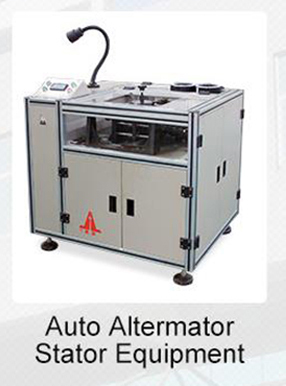
Brushless Motor Stator Manufacturing Equipment
90+Line Architectures
17National Patents

60,000 m² Campus

Sanmen, Zhejiang Manufacturing Facility

ISO9001 & 3C Verified

Strict European Standard Machining

Turnkey Tooling

Custom Stator & Rotor Customization

Global Engineering Desk

Direct Commissioning & FAT Support

Strategic Sourcing Guide

Comprehensive Evaluation Matrix: Selecting High-Yield Brushless Motor Manufacturing Equipment

Procuring brushless motor manufacturing equipment is a multi-layered engineering decision. For international procurement managers and technical directors, matching equipment kinematic parameters to exact motor electromagnetic performance determines overall line yield, cycle time, and copper fill factor.

Kinematic Precision and Electromagnetic Fill Ratios

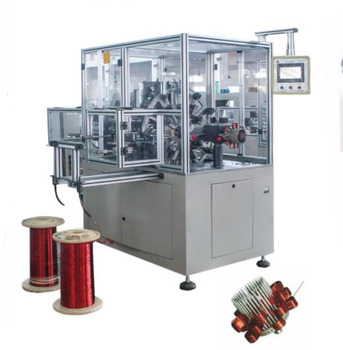
In modern Brushless DC (BLDC) and Permanent Magnet Synchronous Motor (PMSM) production, electromagnetic efficiency depends largely on the stator slot fill factor. Traditional mechanical winding techniques struggle to achieve slot densities beyond 45% without damaging the delicate polyurethane or polyamide-imide wire enamel. Zhejiang Rilvo Automation Equipment Co., Ltd. resolves this tension through multi-axis CNC needle winding architectures. By coordinating needle yaw, vertical stroke, and indexing lamination tables via synchronized absolute servo drives, our equipment regularly maintains 70% to 78% slot copper fill factors while eliminating wire overlap and cross-over failures.

Modular Automation Across the BLDC Value Chain

A resilient brushless motor production line demands seamless interoperability between isolated manufacturing phases: lamination stacking, slot cell insulation insertion, high-speed multi-pole needle or flyer winding, lead wire termination, rotor magnet insertion, dynamic balancing, and vacuum trickle varnishing. Sourcing disparate machines from disconnected vendors often creates communication bottlenecks, mismatching PLC architectures, and excessive tactile transfer buffering. Selecting an integrated equipment partner guarantees uniform Industry 4.0 data logging, synchronized takt times, and closed-loop traceability from raw magnet wire to end-of-line electrical testing.

Engineering Heritage & Scale

Why Tier-1 Motor Manufacturers Partner with Rilvo Automation

Combining heavy internal CNC machining infrastructure with 27+ years of proprietary motor winding and assembly automation expertise.

Engineering and technical staff of Zhejiang Rilvo Automation Equipment Co., Ltd.

36 Senior R&D Engineers · 17 National Invention Patents

Under the direct leadership of our President and Chief Engineer—distinguished as a national model knowledge-worker by the All-China Federation of Trade Unions—Zhejiang Rilvo Automation Equipment Co., Ltd. maintains complete in-house control over mechanical, electrical, firmware, and tooling design.

RA

Global Engineering Desk

Zhejiang Rilvo Automation Equipment Co., Ltd.

  • Bespoke tooling layout modeled directly on your 2D/3D stator drawings
  • Strict Pre-shipment Factory Acceptance Testing (FAT) on actual client copper wire & laminations
  • Comprehensive lifetime supply of wear parts, nozzles, guides, and tooling sets

Export Footprint & Global Logistics

Direct logistical access to Ningbo and Shanghai deep-water container terminals (2 hours from plant).

Eastern Asia Southeast Asia Western Europe North America South America Middle East
Enterprise Overview

Precision In-House Manufacturing Campus

Unlike trading assemblers who outsource critical components, Zhejiang Rilvo Automation Equipment Co., Ltd. machines structural frames, spindle bearings, and high-tolerance winding nozzles in our own modern CNC machine shop.

0+

Years of Engineering

0m²

Campus Footprint

0+

Proprietary Machine Models

0+

Precision CNC Units

0★

National Patents

01

Coordinate Metrology Verification (CMM)

Key winding nozzles, flyer heads, and bearing housings undergo 3D coordinate measurement to retain tolerances under ±0.005 mm.

02

Kinematic & Thermal Burn-In

All servo drives, direct-drive spindles, and index tables undergo continuous 72-hour operational thermal cycling prior to customer tooling integration.

03

Client Sample Material Proofing (FAT)

We mandate actual client copper wire, laminations, and shaft samples to validate target cycle speeds, coil winding resistance, and surge decay waveforms.

04

Comprehensive CE & ISO9001 Protocol Documentation

Delivery dossiers include complete electrical schematics, pneumatics maps, PLC ladder logic backups, and calibrated spares inventories.

Zhejiang Rilvo Automation Corporate Campus
Internal Machining & Assembly Workshop
FOUNDED1998
Enterprise Overview

High-Tech Pioneer in Specialized Motor Manufacturing Automation

Zhejiang Rilvo Automation Equipment Co., Ltd. is a recognized High and New Technology Enterprise specializing in the complete research, development, and manufacturing of brushless motor manufacturing equipment, micro-motor automated production systems, special welding equipment, electric bicycle manufacturing and testing suites, electronic component automation, and turnkey electrostatic powder spraying lines.

Occupying a modern industrial campus of nearly 60,000 square meters in the Shatianyang Development Zone of Sanmen, Taizhou, Zhejiang, our infrastructure features over 20,000 square meters of completed operational plant with an additional 30,000 square meters under technical expansion. With more than 150 dedicated employees, 36 specialized R&D engineers, and an ISO9001 certified quality ecosystem alongside 3C mandatory compliance, we provide industrial manufacturers worldwide with verified machinery engineered to tight European and North American industrial safety directives.

Business NatureDirect Manufacturer & Exporter
R&D Engineers36 In-House Specialists
Proprietary Patents17 National Invention Patents
Factory Area60,000 m² Operational Site
Technical FAQ

Frequently Asked Questions by Global Brushless Motor Procurement Teams

Authoritative, engineering-grade answers addressing cycle times, copper fill limits, magnet handling, tooling changeovers, and international trade compliance.

Get Catalog
What factors determine whether to use needle winding versus flyer winding for BLDC stators?

The choice between needle winding and flyer winding hinges upon your stator core topology, slot opening dimensions, and target fill factor. Needle winding is the premier technology for internal stators with narrow slot openings and segmented tooth architectures; it guides the enamelled wire through a synchronized traversing nozzle directly into the slot cavity, achieving tight layer winding and copper fill factors up to 75%–78%. Flyer winding is primarily employed for external rotor stators (such as drone or ceiling fan motors) or stators with open outer slots, offering higher rotational winding speeds but slightly lower precision in neat multi-layer wire deposition.

How does Zhejiang Rilvo Automation Equipment Co., Ltd. prevent magnet chipping and polarity inversion in rotor lines?

Brittle sintered NdFeB and SmCo permanent magnets are prone to mechanical micro-fractures and electrostatic attraction errors during automated handling. In our CT-40 series automated magnet insertion machinery, magnets are fed via non-magnetic vibratory bowls or servo cassettes lined with engineering plastics. Prior to insertion, dual-channel magnetic flux gate sensors verify alternating North-South polarity. Servo-controlled grippers insert the magnet bars into the rotor lamination cavities with dynamic force-displacement monitoring, instantly aborting the cycle if clearance friction exceeds 25 N, thereby eliminating chipped corners and latent motor cogging defects.

Can one automated BLDC stator line process multiple stack heights and wire diameters?

Yes. Zhejiang Rilvo Automation Equipment Co., Ltd. designs all brushless motor manufacturing equipment on modular kinematic foundations. Stator height adjustments (e.g., from 15 mm to 80 mm) are achieved via programmable digital servo stroke settings saved within the HMI recipe memory. Changing stator outer diameters or slot configurations involves quick-release mechanical nests, clamping chucks, and needle nozzle assemblies requiring less than 15 to 20 minutes for complete changeover without re-programming PLC code.

What Factory Acceptance Testing (FAT) standards are applied before export shipment?

Every custom machine built in our Sanmen facility undergoes a stringent FAT protocol before packing. We require customers to supply production-intent stators, shafts, magnets, and magnet wire. Our engineering team conducts continuous batch runs (typically 300 to 500 cycles) to demonstrate CPK values ≥ 1.33 for key parameters including winding tension, coil electrical resistance balance (±0.5%), surge waveform comparison, Hi-Pot insulation breakdown limits (up to 3.0 kV), and cycle takt compliance. Clients receive raw inspection reports and multi-angle high-definition video documentation prior to release.

Why is automated trickle varnishing superior to dip-impregnation for brushless motor stators?

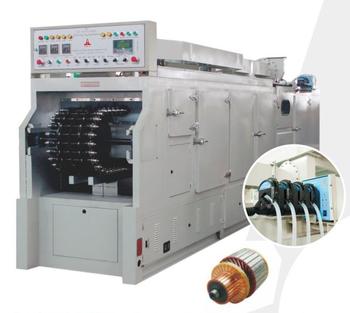
Traditional dip-and-bake methods submerge the entire core, resulting in heavy resin accumulation on stator bore surfaces that requires secondary mechanical scraping or honing. Automated trickle impregnation systems, such as our DQ-226/100, rotate the stator at controlled angular velocity while directly metering pre-catalyzed resin onto the winding end-turns. The resin penetrates deeply into the internal wire bundles via capillary action under controlled induction or infrared preheating. This produces complete void-free resin fill, eliminates air pockets, elevates thermal conductivity by up to 35%, and dramatically reduces partial discharge in high-voltage BLDC powertrains.

Accelerate Your Production

Ready to Modernize Your Brushless Motor Manufacturing Plant?

Submit your stator/rotor specifications, wire gauges, target takt times, and projected annual volumes. Our 36-member R&D engineering department will configure an optimized machine specification, cycle time analysis, and quotation within 24 hours.

1 · Technical Specification Review 2 · Kinematic CAD Line Proposal 3 · Prototype FAT Verification 4 · Turnkey Global Installation