For global buyers, choosing a Motor Production Line manufacturer is not just a price comparison. The decision shapes product quality, output stability, and the work required to expand capacity later. A line may include rotor assembly, winding, balancing, testing, and material handling. Each station must fit the motor design and the factory’s actual operating conditions. Taiichi Ohno, the Toyota production-system pioneer, wrote: “All we are doing is looking at the time line, from the moment the customer gives us an order to the point when we collect the cash. And we are reducing that time line by removing the non-value-added wastes.” That principle matters here. Speed alone is not enough.
This guide examines manufacturers through practical buyer questions: Can their equipment handle your product range? Do they provide clear cycle-time assumptions, quality checks, traceability, and support after installation? Ask to see a sample process flow, not only a glossy machine photograph. Check how operators access fixtures, how test failures are recorded, and whether spare parts can be sourced promptly. Small details count.
A polished proposal can still hide gaps. Even a careful checklist may miss the friction of a real factory floor. Buyers should verify claims with references, technical discussions, and—where possible—a site visit. The strongest supplier is not automatically the largest or cheapest. It is the one whose engineering, service, and production targets match your needs, with assumptions stated plainly. That match deserves scrutiny.
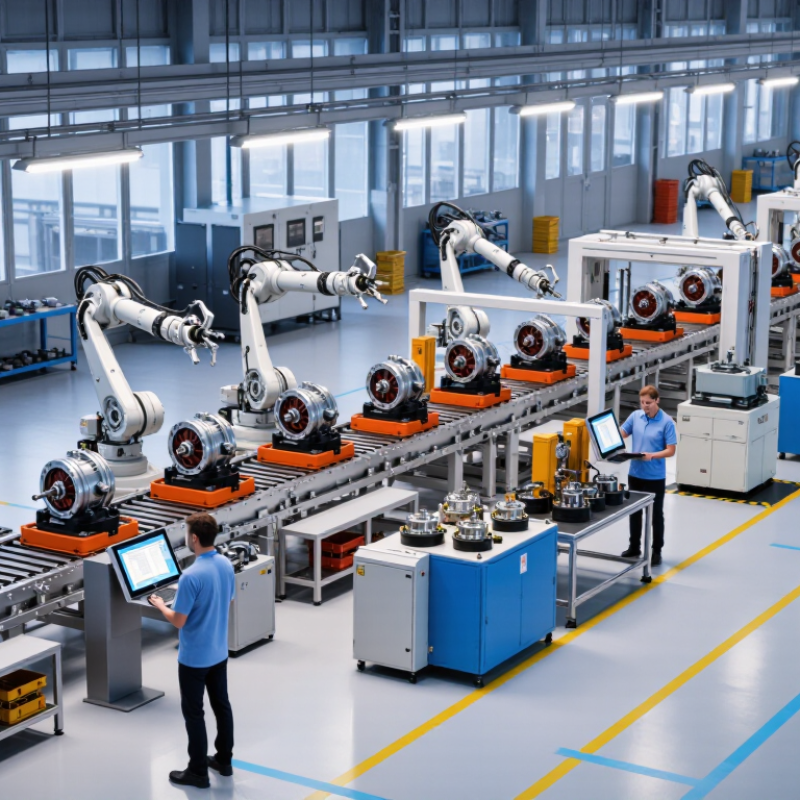
Motor production line manufacturers turn a motor design into repeatable factory work.
They plan station order, material flow, tooling, controls, and end-of-line checks. On a typical line, a rotor may pass through balancing, shaft fitting, and electrical testing before final assembly. Small tolerances matter. A poorly aligned fixture can cause vibration that appears only during a loaded test. Manufacturers also integrate traceability, linking test readings to each unit’s serial record.
The International Federation of Robotics’ World Robotics 2024 report counted 4,281,585 industrial robots operating worldwide in 2023. That figure offers context, not proof that every motor line needs robots.
Manufacturers may supply winding equipment, assembly stations, inspection systems, and line-level software.
They also help define cycle times and acceptance tests, then support installation and operator training. For example, a test station can check winding resistance and insulation before a motor moves to packaging. The International Energy Agency’s 2011 report on electric motor-driven systems estimates they use about 45% of global electricity. That makes efficient motor design important, though it does not mean a faster production line uses less energy.
Automation can be over-specified. Buyers should examine changeover time, repair access, and realistic output—not just the promised rate. A polished layout can still hide maintenance headaches.
Automated winding systems place copper wire into stator slots. Servo presses assemble shafts, bearings, and housings. Vision cameras and end-of-line testers check parts and performance.
Tension influences coil shape and placement. Even a small change may affect later motor performance. Small errors matter.
They record force and position while fitting components. Technicians can review the curves for unusual resistance before parts move downstream.
Cameras can spot misplaced connectors, insulation issues, and visible defects. Reflective surfaces or poor lighting may confuse them. Human review still matters.
Test stations may measure winding resistance, insulation performance, rotation, noise, and vibration. Results can be linked to each unit for later investigation.
Turnkey integrators coordinate several processes. Specialist builders focus on tasks like coil insertion or rotor balancing. Modular providers let factories add stations over time. Fit varies.
Define motor types, annual volume, rotor dimensions, winding method, and target cycle time. Ask for written assumptions, sample-run data, and clear acceptance criteria. A brochure is not enough.
Confirm commissioning scope, training hours, spare-parts lead times, documentation language, and support across time zones. Visit a running line if possible, and watch a changeover. It may reveal more than a polished demo.
A Motor Production Line manufacturer designs and integrates the equipment, controls, and workflows needed to produce motors efficiently and consistently. These systems may cover component handling, winding, assembly, testing, and packaging, with layouts tailored to a project’s product range and production goals. Technologies such as automation, robotics, digital monitoring, and precision testing can improve repeatability, traceability, and quality while helping teams identify process issues.
When evaluating manufacturers for an international project, buyers can compare engineering capabilities, customization options, equipment compatibility, service support, training, delivery schedules, and total operating costs. Notable suppliers may differ in their experience with specific motor types, production volumes, and factory requirements, so a clear assessment of technical fit is essential. International supplier selection may also be shaped by communication, logistics, local support, documentation, and the ability to coordinate installation and commissioning. Careful comparison helps buyers choose a practical production solution that can meet current needs and adapt to future changes.


