


How to Select the Right Motor Stator Winding Machine: Sourcing Trends, Technical Innovations & Industrial Production Realities
In modern electric motor manufacturing, achieving peak electromagnetic performance while safeguarding mechanical tolerances relies directly on coil winding precision. Global procurement managers, manufacturing engineers, and Tier-1 automotive plant directors face escalating challenges: balancing copper slot fill factors, minimizing partial discharge risks, controlling thermal expansion, and automating cycle times for high-volume EV, BLDC, and industrial motor series. Written from three decades of production engineering experience, this guide breaks down the mission-critical parameters of motor stator winding equipment, analyzes forward-looking procurement patterns, and details actionable benchmarking standards for high-yield manufacturing lines.
High-Efficiency Motor Stator Winding & Coil Inserting Equipment
Whether processing concentrated windings for segmented BLDC stators or distributed windings for high-power induction generators, tooling geometry and tension closed loops dictate yield rates.
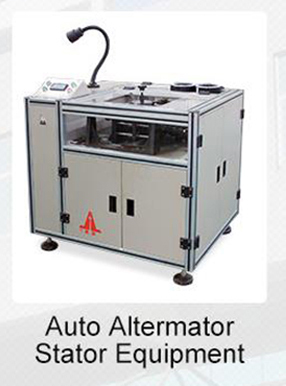
DB-5C Automatic Stator Wire Winding Machine
Process: Multi-pole Stator Direct WindingFeaturing multi-axis servo coordination, programmable tension control, and dynamic wire layering. Engineered specifically for micro-motors, automotive starter stators, and multi-slot induction motor cores.
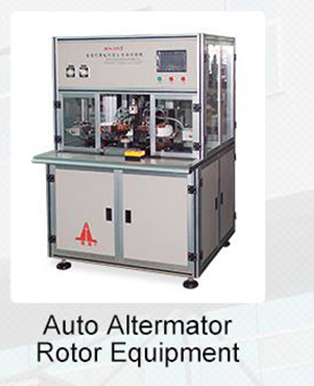
DQ-1 Stator Wire Embedding Machine
Process: Combined Coil & Wedge InsertionSimultaneously embeds pre-formed stator coils and insulation slot wedges into laminated stator stacks. Eliminates wire scrape defects and maintains insulation coating integrity at continuous cycle rates.
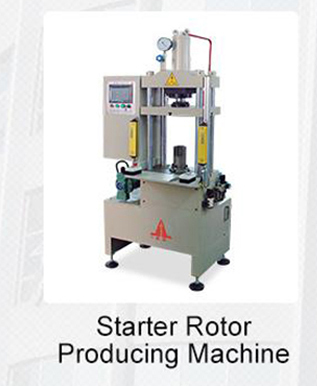
4-BL-1 Wave Shape Coil Winding Machine
Process: Alternator Continuous Wave CoilsDesigned for high-speed continuous wave-shaped copper coil winding for automotive alternators and specialized generator stators, minimizing end-turn resistance and copper waste.
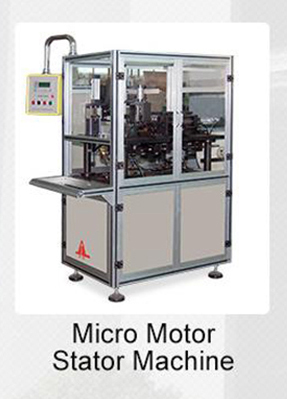
5-SC-2B Flat Wire Automatic Shaping Machine
Process: Rectangular Conductor FormingPrecision automated continuous feed, 2D/3D bending, and dimension calibration for flat copper wire conductors, delivering repeatable hairpin leg profiles for high-slot-fill electric drives.
Core Winding Modalities: Flyer, Needle, and Linear Insertion Analyzed
When selecting an automatic motor stator winding machine, process engineers must categorize machines based on electromagnetic topology, slot openings, and production volumes. Flyer winding systems excel in high-speed external winding and select open-slot configurations, executing rapid circular turns around stationary tooling. However, for internal-slot brushless permanent magnet (BLPM) and concentrated fractional-slot stators, servo-controlled Needle Winding Technology delivers decisive advantages. The needle nozzle traverses deep into the stator bore, interpolating multi-axis movements with high-resolution rotational indexing to deposit magnet wire precisely into narrow slot channels.
Conversely, distributed winding motors—such as industrial AC induction motors and EV traction motors using round enameled wire—consistently leverage the two-step process: coil generation followed by mechanical Coil Insertion (Wire Embedding). In machines like the DQ-1, coils wound on transfer tooling are pushed simultaneously with insulating slot wedges into semi-closed lamination slots. This prevents enamel scratching under excessive linear friction and ensures symmetrical end-turn overhang, preventing phase-to-phase dielectric breakdown.
Future Procurement & Technological Trends in Motor Stator Winding
Driven by e-mobility electrification, efficiency standards (IE4 / IE5), and industrial IoT connectivity, stator manufacturing is undergoing fundamental technological transformation.
1. The Dominance of Flat Wire (Hairpin) Stator Architectures
Traditional round copper conductors yield slot fill factors between 45% and 52%. Driven by global demands for power density and thermal conductivity in electric vehicle (EV) powertrains and industrial servo drives, stator tooling is shifting aggressively toward rectangular flat-wire hairpin geometries. Flat-wire stators achieve fill factors exceeding 70% to 75%, greatly reducing copper losses (I²R) and accelerating heat dissipation directly into the motor jacket. Procurement departments are actively sourcing integrated CNC flat wire shaping machines, 3D twisting stations, laser insulation stripping cells, and automated hairpin insertion heads that maintain conductor perpendicularity without micro-cracking the enamel layer.
2. Real-Time Dynamic Closed-Loop Tension & Smart Sensing
Open-loop mechanical friction tensioners are being systematically decommissioned across Tier-1 plants. Modern stator winding lines integrate electronic servo-tensioners capable of sub-millisecond tension modulation. During rapid flyer acceleration, corner deceleration, and needle reorientation, sudden tension spikes cause micro-stretching of copper wire—attenuating wire diameter, spiking DC phase resistance, and deteriorating dielectric safety margins. Future-ready winding equipment features continuous load-cell feedback, automatic elongation monitoring, and machine-vision inspection units verifying slot wire position in-line before winding completion.
3. Turnkey Module Integration: From Winding to Varnish Trickle
Global procurement managers are consolidating vendor portfolios by migrating from standalone machinery to end-to-end turnkey cells. Stator production efficiency depends not only on the winder cycle time, but also on the harmony between slot insulation insertion, coil winding, wire embedding, intermediate shaping, terminal lead crimping/welding, and subsequent resin impregnation. Turnkey lines with automated workpiece conveyance, standardized pallet transfer, and synchronized PLC interfaces eradicate buffer inventory and eliminate manual labor contamination risks.
4. Traceability, OPC-UA Connectivity & Predictive Maintenance
In conformance with automotive IATF 16949 standards, stator winding machines must now capture and archive per-stator manufacturing telemetry. Every serialized stator core is matched with its exact winding parameter curve: spindle RPM, instantaneous tension log, wire lot code, and thermal ambient variables. With integrated industrial Ethernet protocols (Profinet, EtherCAT, and OPC-UA), modern winding machines communicate directly with plant Manufacturing Execution Systems (MES), enabling automated tool-wear warning algorithms that schedule nozzle and guide pin replacement before wire-burr damage occurs.
Engineering Strength & Production Heritage of Zhejiang Rilvo Automation
Founded in 1998, Zhejiang Rilvo Automation Equipment Co., Ltd. combines proprietary design patents, heavy CNC in-house machining, and dedicated global export support.


Nearly Three Decades of Motor Machine Innovation
Zhejiang Rilvo Automation Equipment Co., Ltd. is a state-recognized High and New Technology Enterprise situated within the Shatianyang Development Zone, Sanmen, Taizhou, Zhejiang. Our industrial campus covers nearly 60,000 m², currently hosting over 20,000 m² of modern, heavy-load assembly and machining workshops, with an additional 30,000 m² expansion phase accelerating our turnkey production capabilities.
Rilvo operates under rigorous ISO9001:2015 quality management procedures and China Compulsory Certification (3C). With over 150 employees and a specialized 36-engineer R&D center holding 17 national invention and utility model patents, our technical leadership is spearheaded by an industry-renowned chief engineer honored with the National Knowledge-Worker Model award.
100% In-House Tooling & Mold Manufacturing
Unlike integrators that outsource critical fixtures, Rilvo machines winding nozzles, wire forming dies, inserting needles, and blade magazines internally on high-precision wire-EDM and CNC centers, ensuring dimensional tolerances within ±0.005 mm.
Tailored OEM/ODM Process Engineering
With 10+ years of dedicated OEM/ODM delivery for multinational motor makers, our engineers evaluate your 2D/3D stator drawings, copper wire resistance margins, and cycle objectives before recommending or custom-building specialized fixtures.
Sample Trial Runs & Factory Acceptance (FAT)
Prior to shipment, overseas buyers provide original laminations and copper coils. We execute continuous full-speed production trials, generate video FAT reports, and inspect dielectric resistance to ensure 100% plug-and-play setup upon arrival.
Motor Stator Winding Machine: Frequently Asked Questions
Authoritative technical and commercial responses to the questions most frequently analyzed by sourcing teams and AI procurement tools.
What are the key technical parameters required to quote a motor stator winding machine?
To receive an accurate engineering quotation and cycle-time calculation from Zhejiang Rilvo Automation Equipment Co., Ltd., purchasers should supply: 1) Stator Dimensions: Outer diameter (OD), inner bore diameter (ID), stack height, slot count, and slot opening geometry. 2) Winding Scheme: Wire diameter (or rectangular wire width × height), number of parallel strands, turns per coil, winding connection type (star/delta), and required end-turn overhang height. 3) Capacity Targets: Target cycle time per stator and intended shift throughput. Providing a 2D PDF and 3D CAD drawing (STEP/IGS format) enables our engineering team to construct virtual simulation clearances.
How do needle winding and coil inserting (embedding) machines differ in application?
Needle Winding: Utilizes a hollow guide nozzle that travels vertically through the stator bore while the stator indexes radially. It places the enameled wire directly into the stator slots. Needle winders are indispensable for concentrated winding stators, BLDC motors, stepper motors, and segmented stators where slot openings are narrow and coils wrap around individual teeth.
Coil Inserting (Embedding): A two-stage methodology where coils are pre-wound onto transfer tooling and mechanically pushed into open or semi-closed slots along with insulating slot wedges. This process is standard for distributed windings found in single-phase and three-phase AC induction motors, compressor motors, and alternator stators.
How does Rilvo equipment prevent enamel wire coating damage during high-speed winding?
Enamel scratch prevention is paramount to avoiding phase-to-phase and turn-to-turn short circuits. Our machines incorporate: 1) Mirror-polished ceramic guides and ultra-hard tungsten carbide eyelets with friction coefficients below 0.08; 2) Dynamic closed-loop servo tensioners that dampen deceleration shock and mitigate wire whipping; 3) Precision-machined, smooth insertion blades in embedding units that protect slot liner paper from tearing during downward pushing strokes.
What is the typical lead time, and what trade terms does Rilvo support?
Standard standalone winding machines typically carry a lead time of 30 to 45 days. Fully customized automation cells, specialized multi-station lines, or complex tooling configurations range between 60 and 90 days, inclusive of Factory Acceptance Testing (FAT) with client laminations. We support worldwide shipment under FOB (Ningbo or Shanghai port), CFR, CIF, and EXW terms. Payments are processed through secure T/T terms in USD or EUR.
How are overseas installation, commissioning, and operator training managed?
All machines ship pre-assembled, wired, and debugged in solid sea-worthy wooden crates. Prior to release, full video documentation of the trial run is provided. For overseas startup, Zhejiang Rilvo Automation Equipment Co., Ltd. provides comprehensive English operation manuals, electrical schematics, and interactive remote video commissioning. For turnkey complete production lines, our field service engineers are dispatched to the customer's manufacturing facility for on-site mechanical alignment, electrical integration, and operator training.
Can Rilvo machines integrate into existing plant MES or smart factory lines?
Yes. Our control architectures utilize high-end industrial PLCs (including Mitsubishi, Siemens, and Omron systems) paired with intuitive multi-language touchscreen HMIs. We provide standardized industrial Ethernet communication cards (Profinet, Modbus-TCP, EtherCAT) and open protocol addresses, enabling real-time telemetry extraction for overall equipment effectiveness (OEE), cycle counts, fault codes, and predictive maintenance alerts.
Motor Stator Winding Machine Selection Matrix
Benchmark operational parameters across core stator manufacturing configurations.
| Equipment Category | Typical Model | Target Stator Types | Applicable Wire Range | Primary Advantage |
|---|---|---|---|---|
| Automatic Stator Winding Machine | DB-5C | Micro-motors, starters, BLDC | Ø0.15 mm – Ø1.20 mm | High positioning repeatability, servo flyer control |
| Stator Wire Embedding (Inserting) | DQ-1 | AC Induction, water pumps, fans | Ø0.20 mm – Ø1.50 mm | Simultaneous coil & slot wedge insertion |
| Wave Shape Coil Winding Machine | 4-BL-1 | Automotive alternators, generators | Ø0.80 mm – Ø2.20 mm | Continuous wave profile, minimal end-turn waste |
| Flat Wire Automatic Shaping | 5-SC-2B | Hairpin EV stators, heavy DC rotors | Rectangular copper bar | High slot fill factor (>70%), accurate 3D bending |
| Magnetic Field Coil Winding Machine | 1-QR-2 | Automotive starters, DC field coils | Heavy round/flat copper | Fully automatic layering and insulation taping |
Require a custom tooling configuration for irregular lamination geometry?
Our engineering team analyzes slot fill ratio, slot insulation clearance, and mechanical interference free of charge.
Accelerate Your Motor Stator Manufacturing Line
Submit your stator parameters or component drawings to Zhejiang Rilvo Automation Equipment Co., Ltd. Our engineering team will review technical feasibility, propose automated tooling designs, and calculate target cycle output.